
Building a Mind That Won’t Wander
Why Your Focus May Feel Broken
When researcher Gloria Mark began tracking screen attention in 2004, she found that people could stay focused on a single task for roughly two-and-a-half minutes before switching. Two decades later, that number had collapsed to about 47 seconds. Perhaps not coincidentally, this attention decline parallels the rise of social media to become our dominant mode for consuming content.
If you’ve felt your focus fraying lately, you’re not imagining it, and you’re not simply undisciplined. Today’s attention economy is designed to keep us passively consuming content, often undermining our ability to concentrate and stay motivated. Fortunately, focus and motivation are skills we can rebuild. Four interconnected strategies make this possible: cognitive engagement, distraction management, environmental recovery, and attention training.
Cognitive Engagement
Cognitive engagement means actively thinking, questioning, puzzling over, and interacting with material rather than passively absorbing it. Optimal cognitive engagement occurs when three conditions are present:
The activity provides the right level of challenge.
The goal of the activity is clear and feedback is available.
The activity requires active participation or problem solving.
The right level of challenge matters because tasks at either extreme are easy to abandon. When work is too easy, boredom and apathy set in; when it’s too difficult, you may be overcome by frustration and discouragement.
Conversely, the right level of challenge creates the opportunity for flow – the familiar and sought-after experience of becoming so absorbed in an activity that time seems to fade into the background. Look for tasks challenging enough to require your full attention, but manageable enough that steady effort feels worthwhile.
A clear objective and ongoing feedback further support cognitive engagement. You know what you’re trying to accomplish, you can see whether your efforts are working, and you can adjust when they are not. Dopamine, long mischaracterized as a pleasure chemical, turns out to be much less involved in the enjoyment of a reward than in the drive to pursue one; it helps make progress feel inspiring. A checklist, a practice log, a word-count target, or feedback from a coach or colleague can all transform a goal you’ve been procrastinating on into a motivating series of next steps.
Finally, choose activities that demand something of your mind, especially ones that require creativity or strategic thinking. Some examples include chess or sudoku, learning an instrument or language, writing, martial arts, or dance. The shared benefit of each of these activities is that they move you from passive consumption to active participation – the mental environment in which focus and motivation grow.
Distraction Management
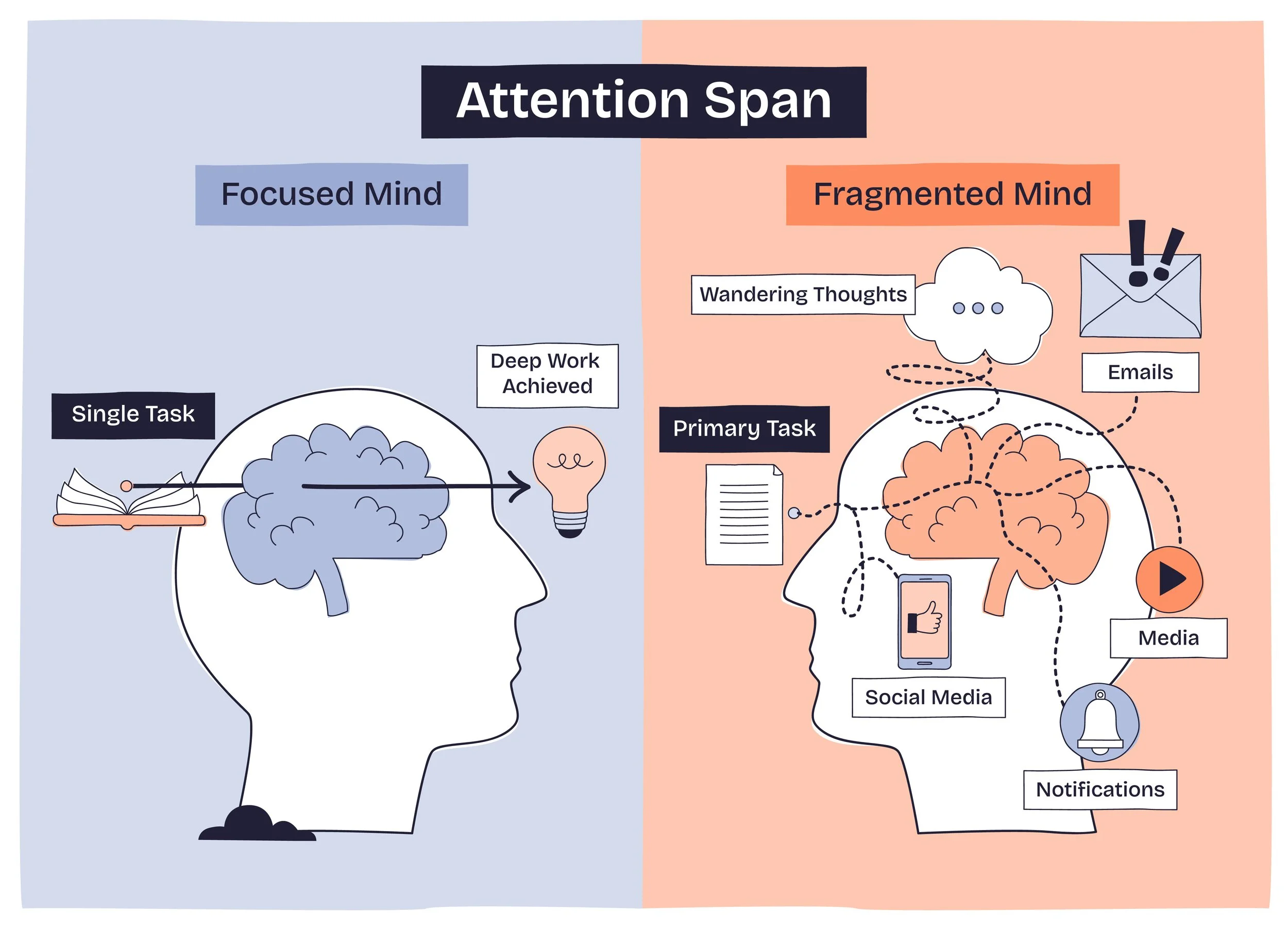
Even the best-designed challenge struggles to compete with a notification banner. The good news is a few practical changes to your environment can reduce the amount of distraction you have to resist in the first place:
Manage screen time: monitor usage and set limits for non-essential apps
Create physical boundaries: designate distraction-free workspaces, and leave devices in another room during focus or family time
Schedule device-free periods: make room for hobbies, recreation, family time, or simple presence
Contain email: schedule specific times for checking, and use filters and folders to sort efficiently
Curate social media: unfollow or mute accounts that don’t enrich, inform, or constructively challenge you
One popular way to put these principles into practice is the Pomodoro technique: choose a task, work on it without checking email or social media for a set interval – traditionally 25 minutes – then take a short break. The research here is mixed, so treat this as an experiment rather than a rule. In one recent study, Pomodoro-style breaks increased fatigue more quickly than self-paced work, while another found the opposite: 20% lower fatigue and improved sustained focus.
Environmental Recovery
Much like physical energy, attention can become depleted and needs recovery. Attention Restoration Theory, developed by psychologists Rachel and Stephan Kaplan, proposes that directed attention – the effortful kind you use at work, planning, and self-control – gets fatigued throughout the day. Time in natural or nature-mimicking environments may restore your capacity for directed attention through what they call soft fascination.
Soft fascination is an effortless, pleasant form of attention triggered by things like moving water, rustling leaves, shifting clouds, or a dramatic sunset. These stimuli gently occupy the mind without placing heavy demands on directed attention.

What makes the natural environment special? The Kaplans identified four specific properties that make an environment restorative:
Being away – the restorative environment must feel substantially different than your everyday setting.
Extent – the environment needs adequate scope and coherence; a houseplant or fish tank probably isn’t enough, but a well-kept garden could be.
Stimulates soft fascination – found abundantly in nature, but scarcely in urban environments.
Compatibility – aligned with your current purposes and inclinations; a walk in which you’re being pestered by bugs or worried about getting lost won’t work.
Research on environmental recovery suggests that even brief time in a green space produces measurable restoration. In addition, natural design elements in your workspace such as plants, natural light, views of greenery, and even nature sounds, all engage soft fascination and can slow the depletion of directed attention.
Attention Training
The practice of mindfulness can strengthen the skills that support focus. Regular practice may develop concentration, reduce stress, expand capacity for creativity and problem solving and, most importantly, improve your ability to guide your attention.
A simple place to start is focused-attention meditation. Sit quietly for a few minutes and rest your attention on the physical sensation of breathing, a sound in the room, or another neutral anchor. When your mind wanders, notice it without judgment and reset your attention. Guided meditations can provide structure if open-ended silence feels intimidating.
The goal is not to eliminate distraction, but to notice it sooner and return to your intended task more quickly.
You can also build this focused-attention skill into activities of daily life: take a phone-free walk, eat a meal without multitasking, give someone your full presence during a conversation, or exercise without additional background input. Movement-based activities like tai chi can be especially useful because they demand awareness of breath, balance, timing, and body position. Each offers opportunities to bring your attention to the present moment.
A 2025 USC eye-tracking study found that just 30 days of guided meditation improved the speed and accuracy with which participants directed their attention toward relevant targets. They also showed greater resistance to visual distraction, with benefits observed across all age groups.
In Summary
Focus and motivation are not fixed traits, but skills built through the conditions you create and the habits you rehearse. Start with one change today: find a creative task that offers you the perfect challenge; seek out and eliminate unnecessary distractions; schedule regular time in a restorative or natural environment; or try a focused-attention meditation. With regular practice, you’ll find your focus and motivation strengthen naturally.
